









Follow-up or multiple operations
Many patients turn to us when they are at the end of their strength — after one or more nasal operations that did not bring the desired result. Whether it is a shape that does not suit the face, persistent breathing difficulties or visible scars: the wish to have an unobtrusive nose again is understandable — and the strain until then is real.
- Four in ten operations here
- Cartilage from ear or rib where needed
- Operation 1 to 4 hours
- At least 12 months in between
As a reference centre for facial surgery at the Kuzbari Centre for Aesthetic Medicine in Vienna, we carry out such corrective operations very frequently.
Four in ten nasal operations at the Kuzbari Centre are revision rhinoplasties on a nose that has already been operated on. Such procedures call for particular experience: the tissue is scarred, cartilage is sometimes missing, and the starting point is different for every patient. We deliberately take on such cases.
The Kuzbari experts for this service:


- 2,000+Nasal operations
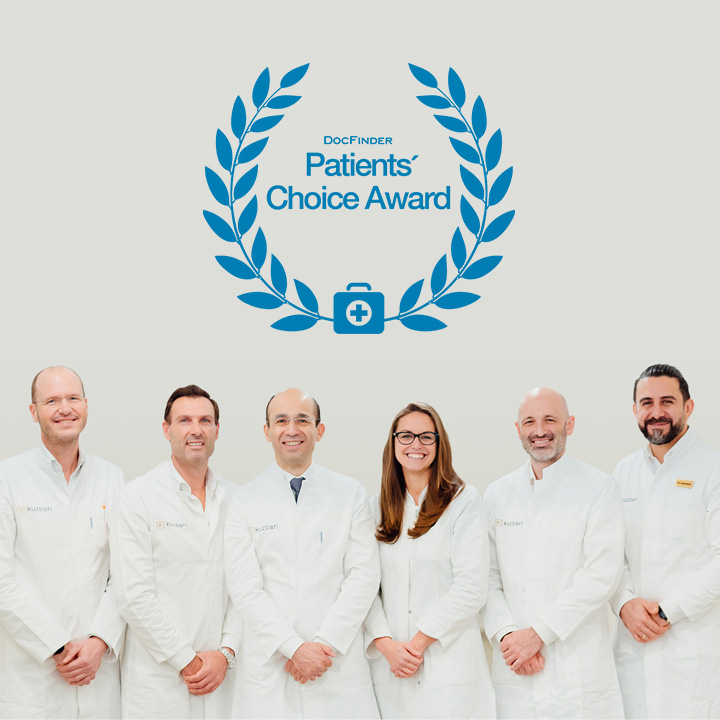
- 3Nasal surgery specialists
- 11Times in a row Patients’ Choice Award
- 38DocFinder awards in total
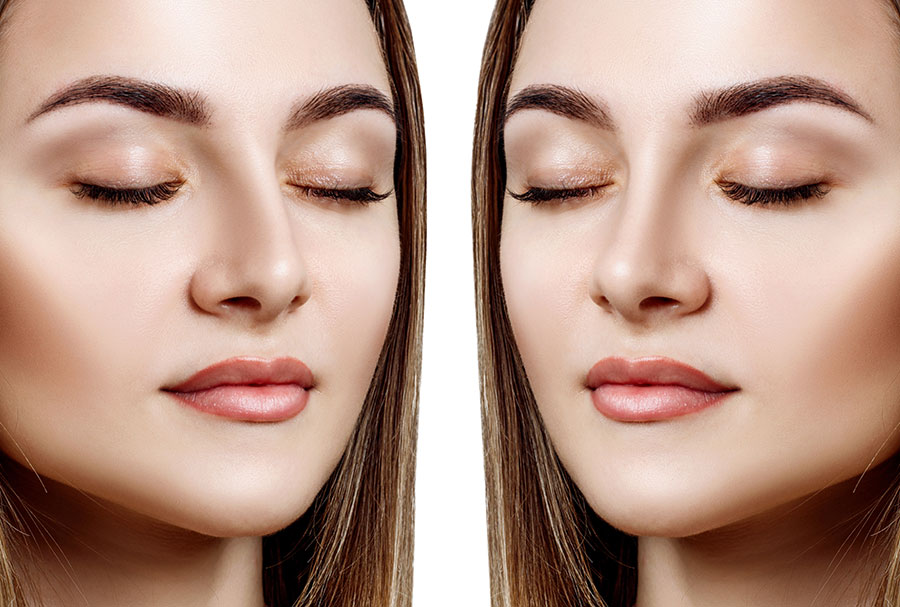
A new chance at a natural result
This specialisation allows us to treat complex cases with great precision and to give patients a new chance at a harmonious, natural result.
On this page you can read what a corrective operation involves, what challenges it brings with it, when the right time for it is and how we proceed at the Kuzbari Centre.
What is a follow-up or multiple operation?
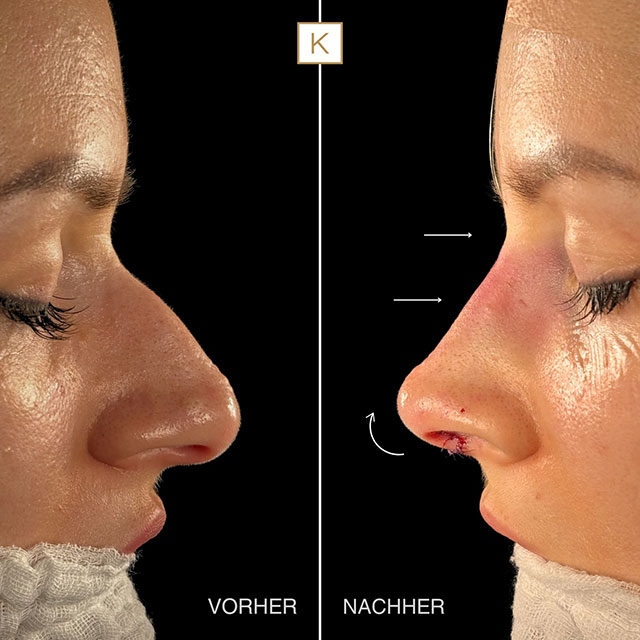
A corrective operation, also called a revision rhinoplasty, is a second or third nasal correction that changes the result of an earlier procedure. It addresses deviations in shape, asymmetries, functional problems such as obstructed breathing, or visible irregularities.
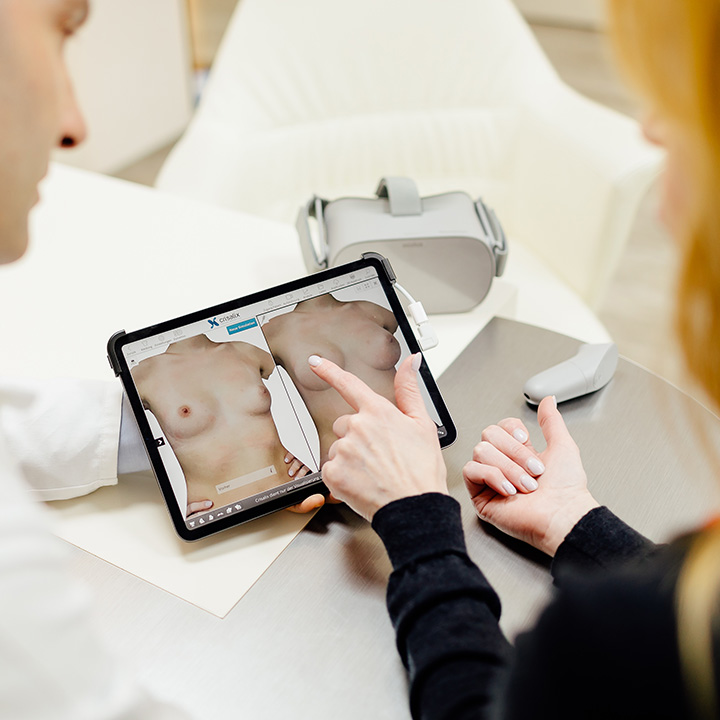
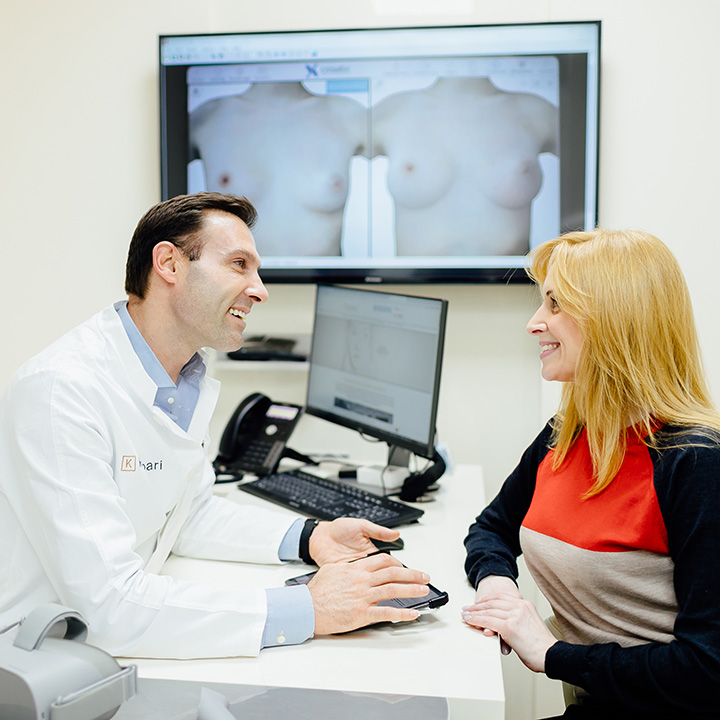
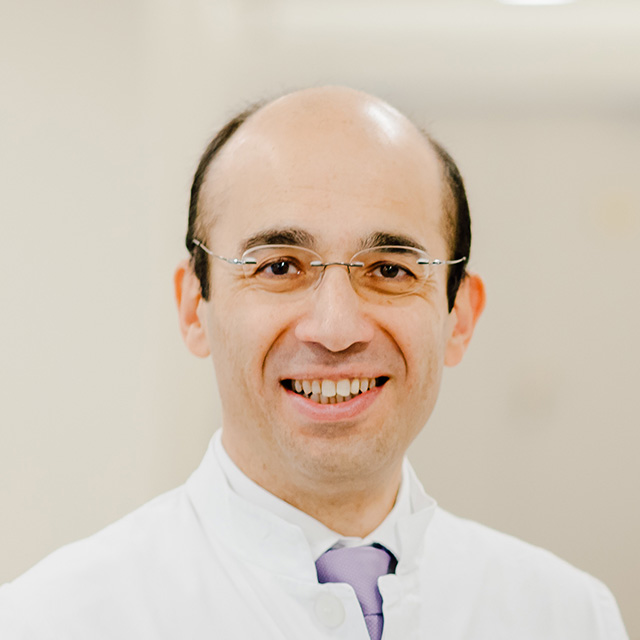
Follow-up and multiple operations on the nose are carried out at the Kuzbari Centre by Univ. Doz. Dr. Rafic Kuzbari and Dr. Christoph Grill — two surgeons who have worked intensively with the previously operated nose for years. Thanks to our Vectra 3D simulation you can see beforehand in which direction your nose can change — a decisive step in bringing expectations and possibilities into line.
The most important difference from a first operation is not the technique but the starting point. In an untouched nose the structures lie where the anatomy places them. In a previously operated nose they lie where the first operation left them — and in between there is scar tissue, which behaves differently from healthy tissue. A revision therefore always begins with a careful assessment: what is still there, what is missing, and what can be built from it?
Why patients come to us
The concerns resemble one another, and they almost always have two sides: a physical one and an emotional one. Many describe that their nose no longer suits their face after a previous operation — a tip that has become too pointed, a sunken area on the bridge or a visible edge. Others come because breathing did not improve after the procedure, or even became worse.
Emotionally the strain is often considerable: the daily look in the mirror recalls a decision that did not bring what was hoped for. Insecurity, social withdrawal and the feeling of being alone with the subject are frequent companions. We listen to that before we talk about technique. And we take the time for it: anyone thinking about a nasal operation for the second time needs different answers than the first time — more precise ones, more cautious ones and, above all, more honest ones.

Why breathing is so often part of it
The septum is the load-bearing pillar of the nose and at the same time the wall between the two airways. If cartilage is taken from it during an operation, or if it is weakened, that changes both at once: the mechanics of the outer nose and the flow of air inside.
This is why in a revision we always examine nasal breathing from the inside as well — even when you come to us only because of the shape.
Revision rhinoplasty at a glance
- Aim of the operationImproving form and function after a previous operation
- Interval since the previous operationAs a rule at least 12 months
- Duration1 to 4 hours
- AnaesthesiaGeneral anaesthesia
- StayOne night as an inpatient
- MaterialYour own cartilage, often from the ear or a rib
- Nasal packingNot necessary
- Fit for workAfter 3 to 7 days
- Fit to socialiseAfter 1 to 3 weeks
- Final resultAfter 6 to 12 months, later with thick skin
Guide values for a revision at the Kuzbari Centre. What applies to you depends on the starting point and is established after the examination.
The challenges of corrective operations
Multiple operations are more demanding than first procedures. The anatomy has changed: cartilage and bone may be deformed, tissue scarred or in places no longer present. Scar tissue makes dissection harder, and healing often takes longer because the blood supply has changed.
| Feature | First operation | Revision |
|---|---|---|
| The tissue | Untouched; the layers separate cleanly from one another. | Scarred; skin, muscle and framework are stuck together. |
| The cartilage reserve | The septum usually supplies enough material. | Often already used up; cartilage from the ear or a rib becomes necessary. |
| The blood supply | Normal. | Altered; healing takes longer and the swelling lasts longer. |
| The planning | Follows the anatomy. | Follows what is left of the anatomy. |
| The operating time | At the lower end of the range. | Usually at the upper end — which is why we operate without time pressure. |
What we rebuild with
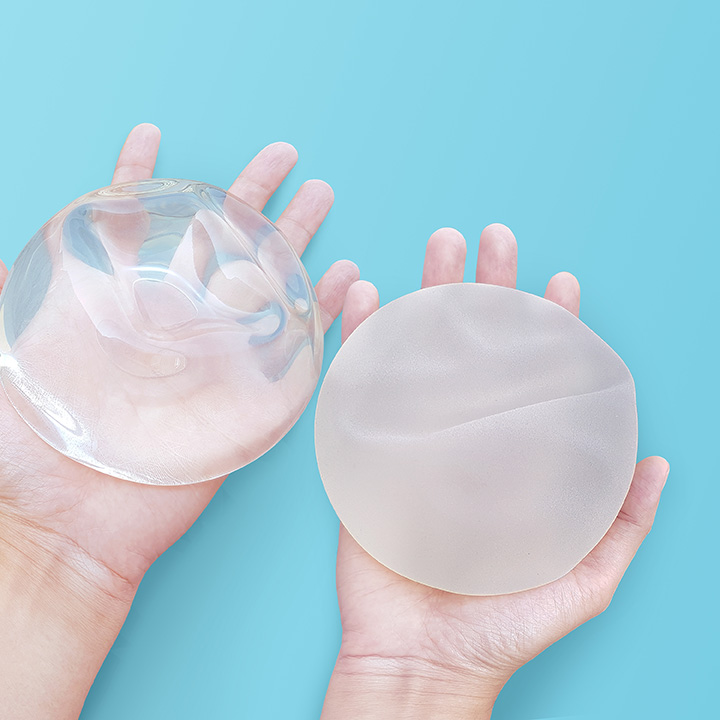
If cartilage is missing it has to be replaced. If the septum still holds enough, we take the material from there — without an additional incision outside the nose. If it is already used up, ear cartilage is an option; for larger reconstructions rib cartilage, which is stable enough to replace load-bearing parts of the framework. Soft contours can additionally be covered with your own fascia so that no edges show through thin skin.
For the nasal tip the same applies as in any other nasal operation, only with less room for manoeuvre: we stabilise it using modern cartilage-supported techniques. This considerably reduces the risk of drooping of the nasal tip over the years. If the nasal bridge is still largely intact, the nose-bridge-preserving technique, known as dorsal preservation, and hybrid techniques can be an option in a revision too — the natural nasal bridge is preserved instead of being removed and rebuilt.
What we can promise and what we cannot
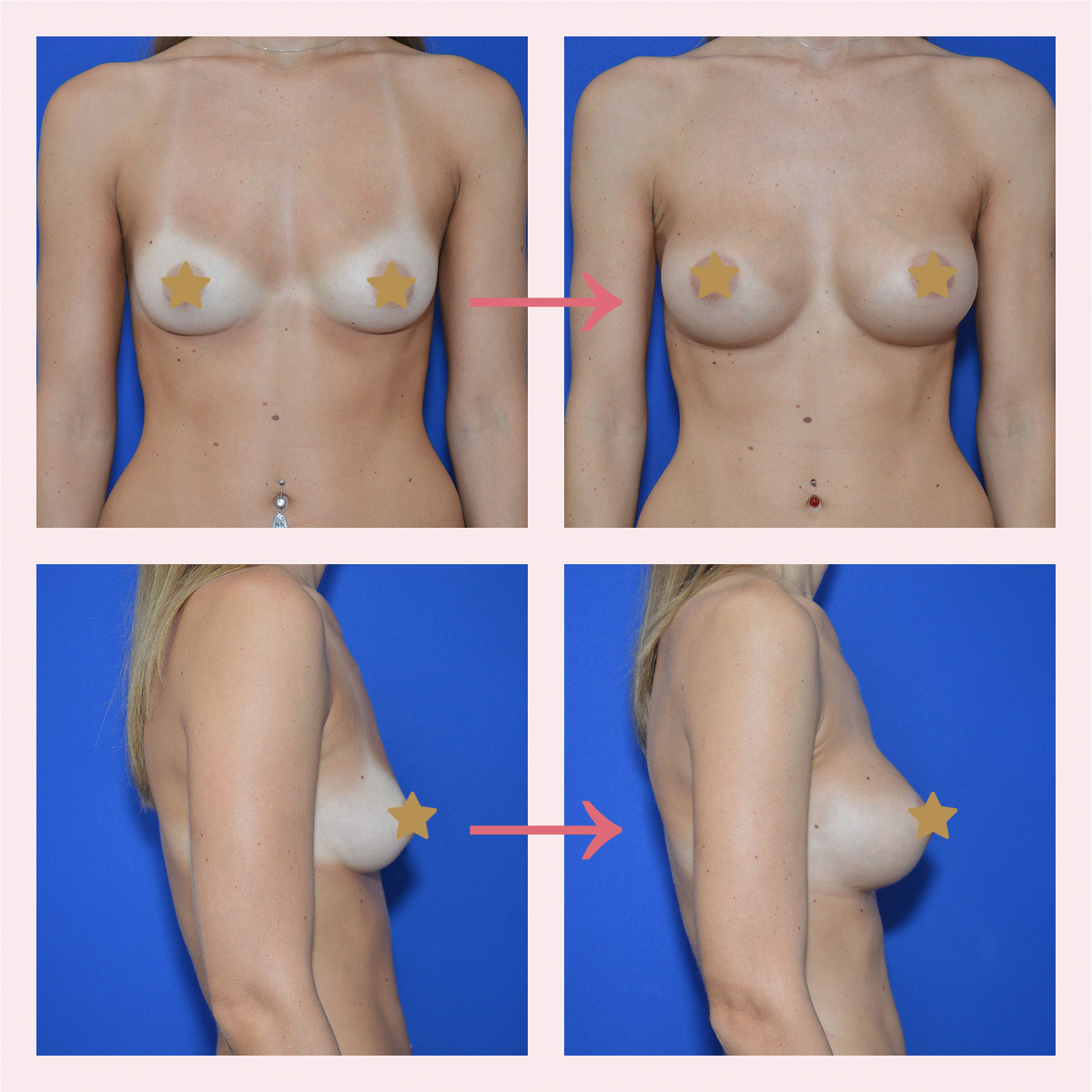
In a revision the achievable result depends more strongly on the starting point than in any first operation. Existing damage has to be addressed first, for instance by removing material, by a scar revision or with tissue grafts from your own body. Some things can be corrected completely, others improved considerably, and in a few places a trace remains.
We tell you this before the operation, on your own images and on the 3D simulation. With a revision an honest expectation is the most important part of the preparation — and the best protection against a third operation.
The right time
The most common mistake with revisions is operating too early. After a rhinoplasty the nose changes over months; the final result shows itself after six to twelve months, with thick skin occasionally only after eighteen. As long as the swelling has not fully subsided, it cannot be judged with certainty what genuinely needs correcting and what is still only swelling.
We therefore usually wait at least twelve months after the previous operation. The tissue has to be healed and soft before it is moved again. Come for a consultation earlier all the same: we look at the course things have taken, put into context what you are seeing, and tell you whether waiting is worthwhile. In rare cases — with clearly obstructed breathing, for instance — an earlier procedure can make sense.
The procedure, step by step
Consultation, planning, operation, inpatient care and aftercare all take place in the same building.
- Initial consultation and assessment
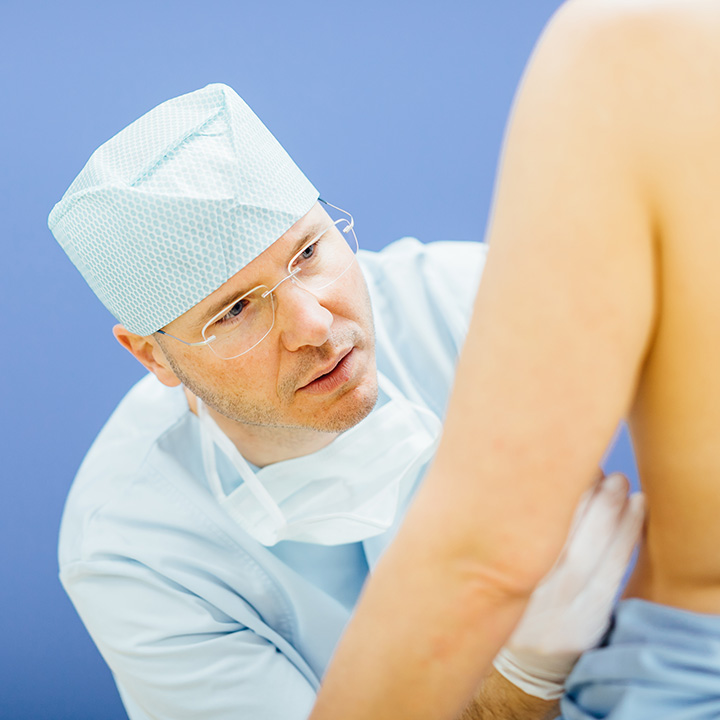
We listen — to your history as well. We examine the nose from the outside and from the inside, check breathing, assess skin, scars and framework and review the operation report of the previous procedure. Afterwards you know what is still there and what has to be replaced.
- 3D simulation
Our 3D simulation shows your future nose not only in profile but also from the front and from below. You see your possible result from exactly the angles from which others see you every day — and before the operation we talk about the same picture.
- Planning and preparation
The consent discussion, your medical history and laboratory values, anaesthetic preparation in the building. If rib cartilage is needed, we discuss the harvesting, the additional scar and the healing at the chest in detail beforehand.
- The operation
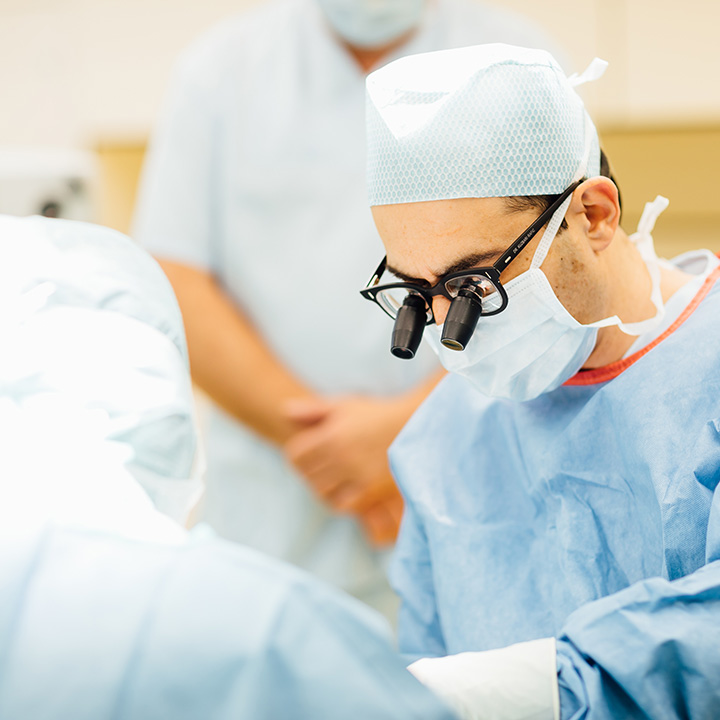
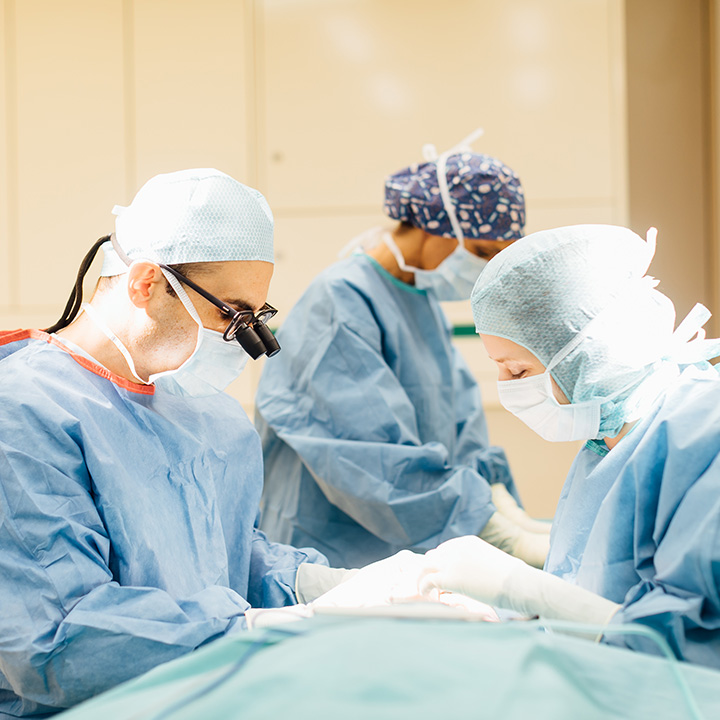
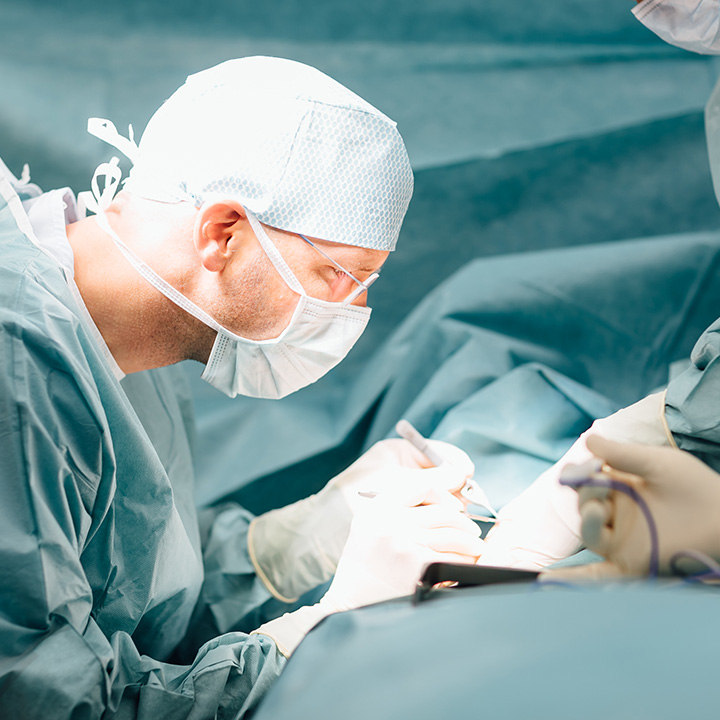
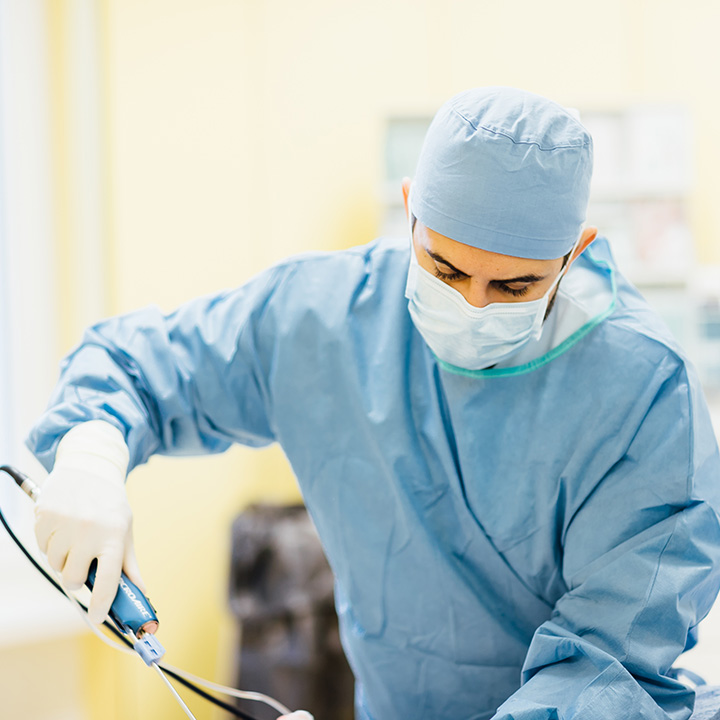
The operation takes place in the centre's own operating theatres, under general anaesthesia. A rhinoplasty here takes one to four hours. That range is deliberate: we operate in our own operating theatres and therefore without time pressure — for as long as it takes for every detail to be right. How long a procedure takes is decided by the findings, not by the appointment schedule. With a revision the duration is usually at the upper end.
- Inpatient in the building
After the recovery room you spend one night in a patient room of your own. The nursing staff is there around the clock. Nasal packing is not necessary.
- Healing and check-ups
Most people are fit for work after three to seven days and fit to socialise after one to three weeks. Because of the scar tissue the swelling after a revision often lasts longer than the first time — that is to be expected and is not a bad sign.
- The fine shape
The final result shows itself after six to twelve months, with thick skin also later. All check-up appointments up to that point are included.
Our expertise and all-round care
At the Kuzbari Centre we combine medical skill with empathy. In a tense situation we listen first and take the frustration seriously. Univ. Doz. Dr. Rafic Kuzbari and Dr. Christoph Grill, our specialists for multiple operations, work with a focus on a natural result and on low risks.
We operate as an inpatient procedure with one overnight stay, including the Kuzbari Safety Check and quality guarantee. Most people are fit to socialise after one to three weeks; after that we accompany you with check-up appointments until the result is settled.
- We do not pass judgement on where or by whom the first operation was carried out. We look at what is there now.
- Before the operation we tell you what can be corrected completely, what can be improved and where a trace will remain.
- We would rather wait until the tissue is ready than operate early and have to correct again.
- We plan the cartilage requirement in advance so that nothing has to be improvised in the operating theatre.
- Whoever advises you also operates on you — and sees you again at every check-up.
Everything under one roof
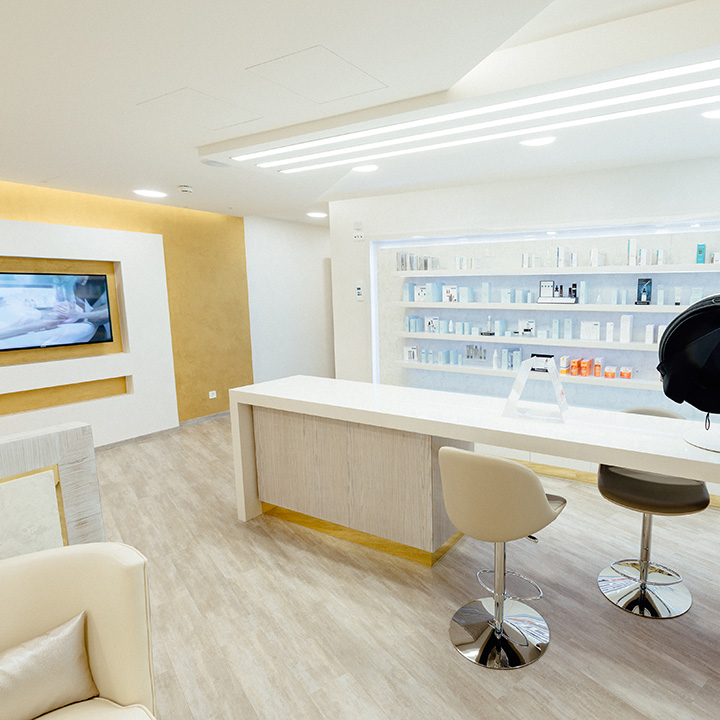
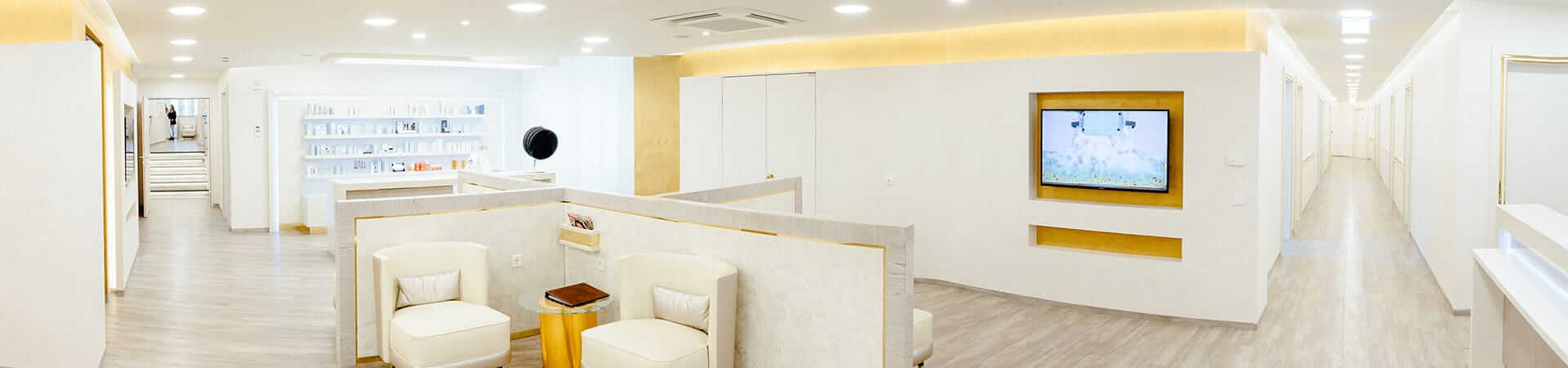
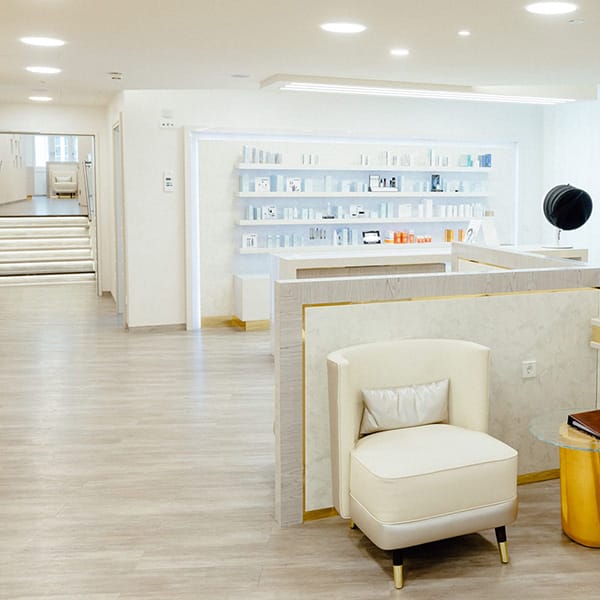
The Kuzbari Centre has its own operating theatres, equipped for rhinoplasty — and therefore the luxury of free scheduling. With a revision that matters especially: it cannot be planned to the minute beforehand how long releasing scar tissue will take.
Our well-rehearsed team of doctors, anaesthetists and practice assistants works exclusively in aesthetic medicine. More about the 360° nasal surgery centre
Who takes on revision operations
Whoever advises you also operates on you — and sees you again at the check-ups.
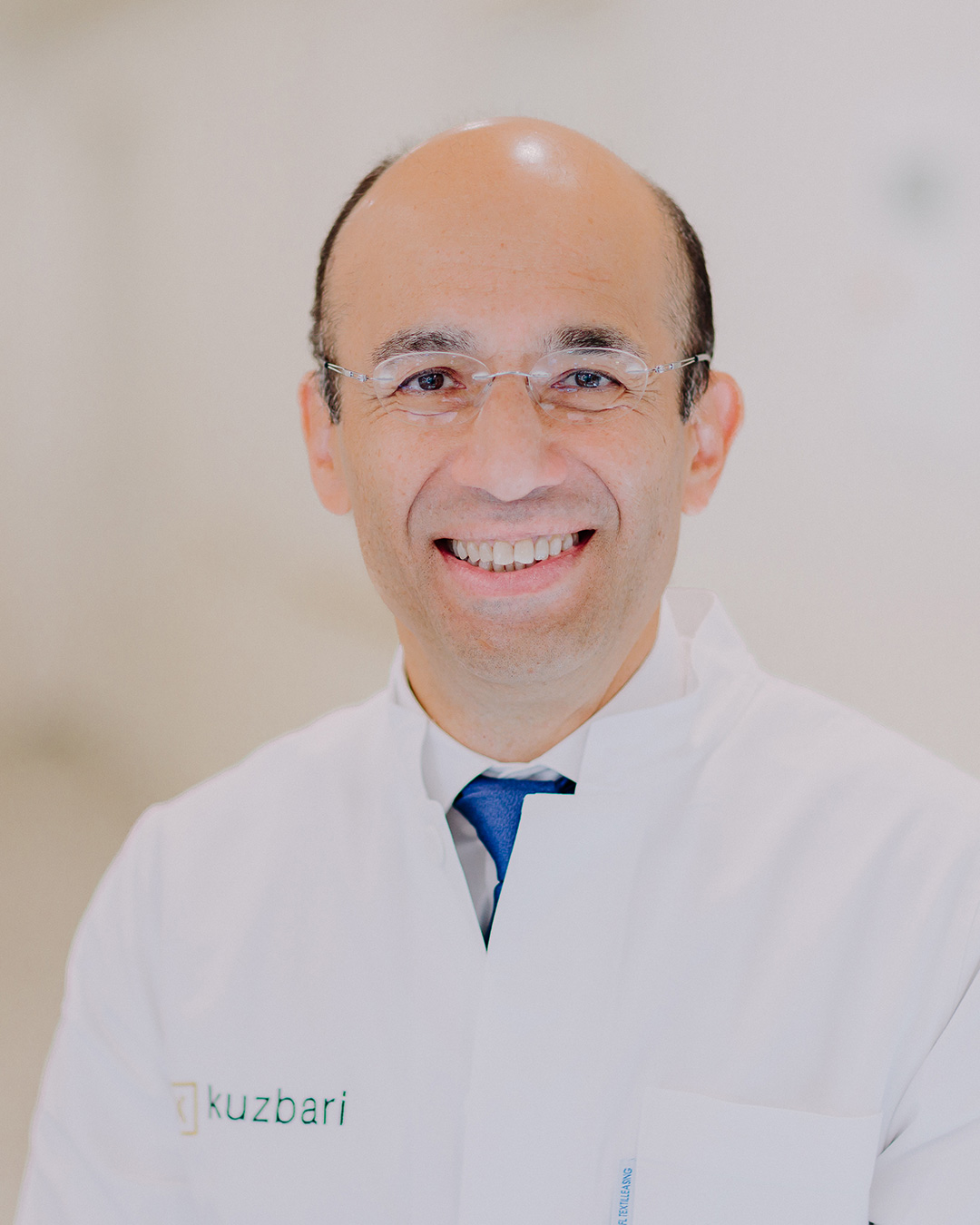
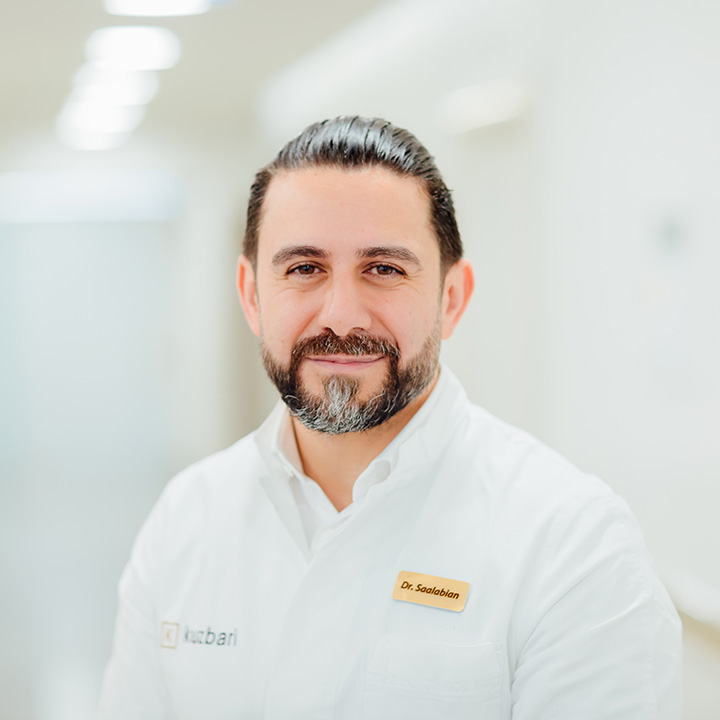
Founder of the Kuzbari Centre. He also takes on difficult revision operations and has worked with the piezotome for years.
To the profile
Works exclusively on the face and, where the findings are suitable, with the nose-bridge-preserving technique.
To the profileCosts
A revision costs more than a first operation. The reason is the effort involved: scar tissue has to be released, missing cartilage replaced and frequently a graft taken from the ear or a rib. The operating time, too, is usually at the upper end of the range.
- Initial consultation and 3D simulationincluded
- Operation, anaesthesia and assisting teamincluded
- Overnight stay and cateringincluded
- All check-up appointmentsincluded
An initial consultation with three-dimensional simulation, a technique that suits your nose, and an operating time determined by the findings — this effort is the reason why a rhinoplasty has its price here. It is also the reason why the result is meant to last: a lifetime, not a few years.
The costs can be spread over up to five years through Kuzbari Finance, at an annual percentage rate of 9.99 %.
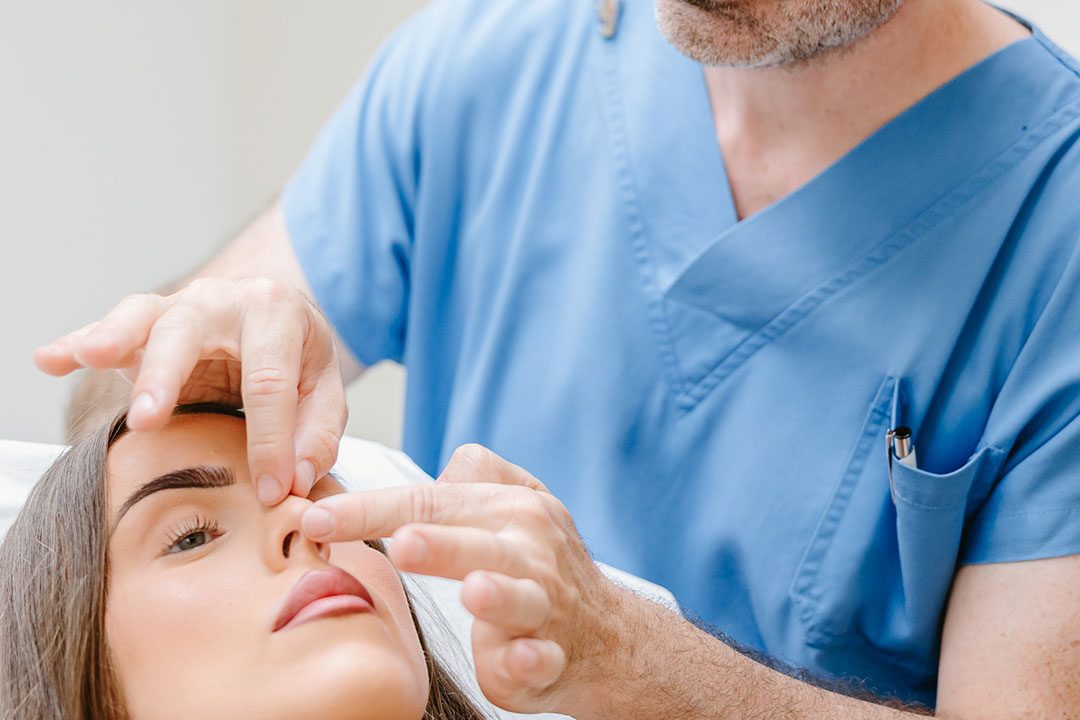
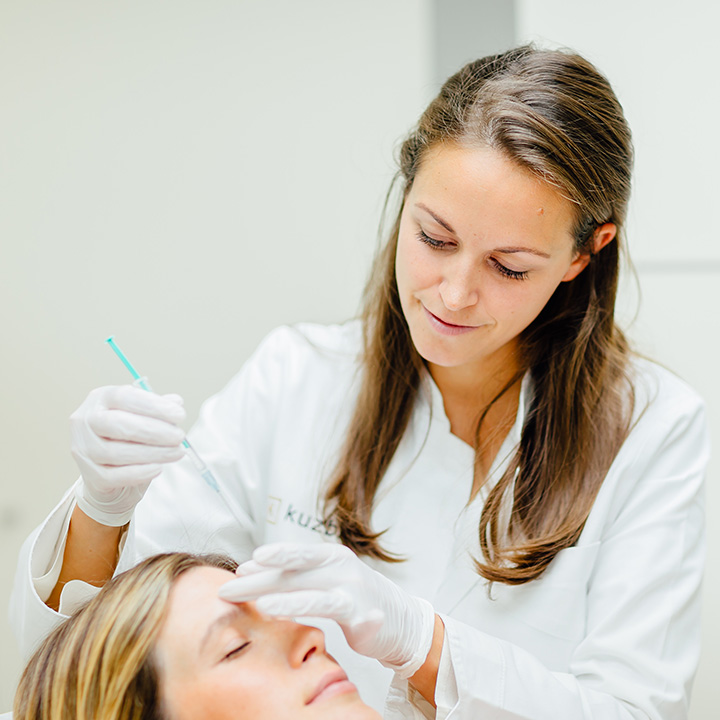
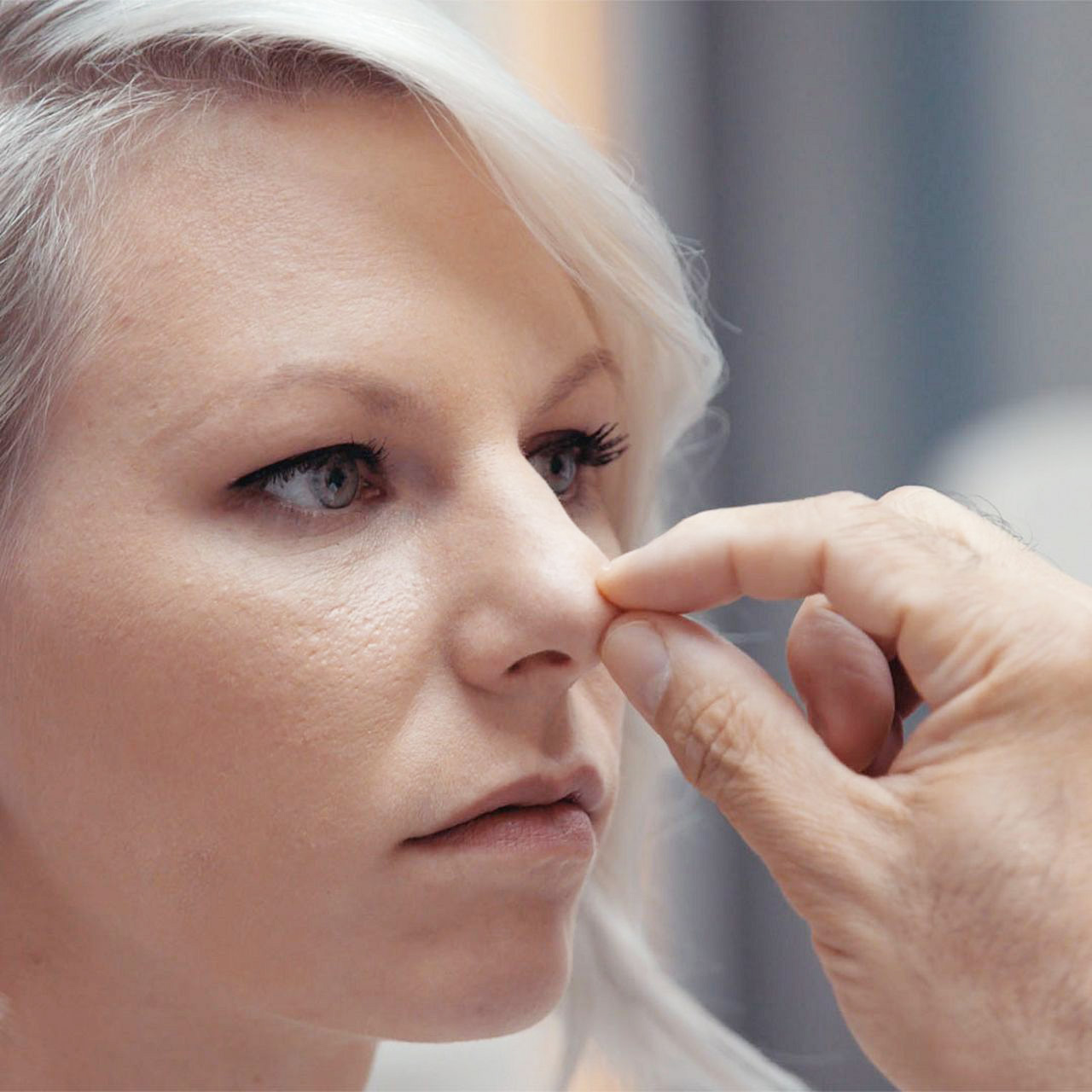
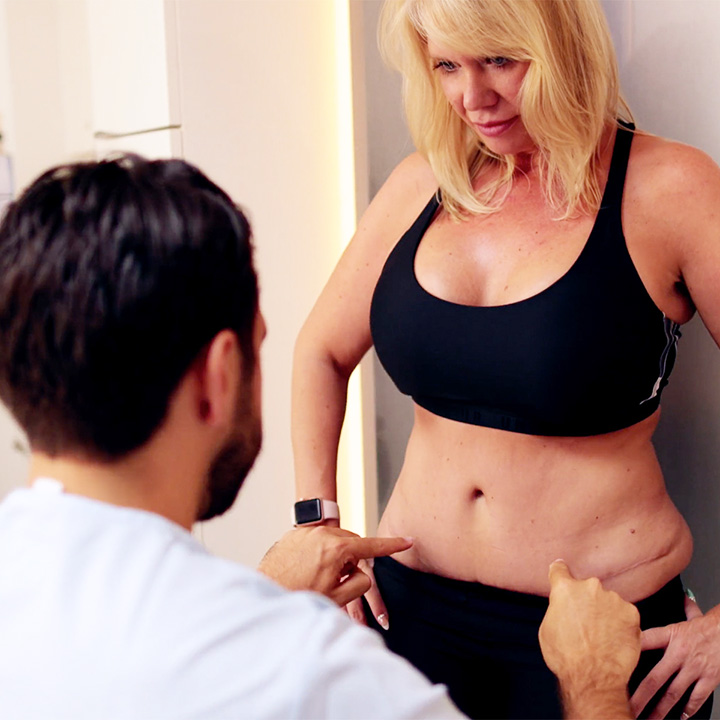
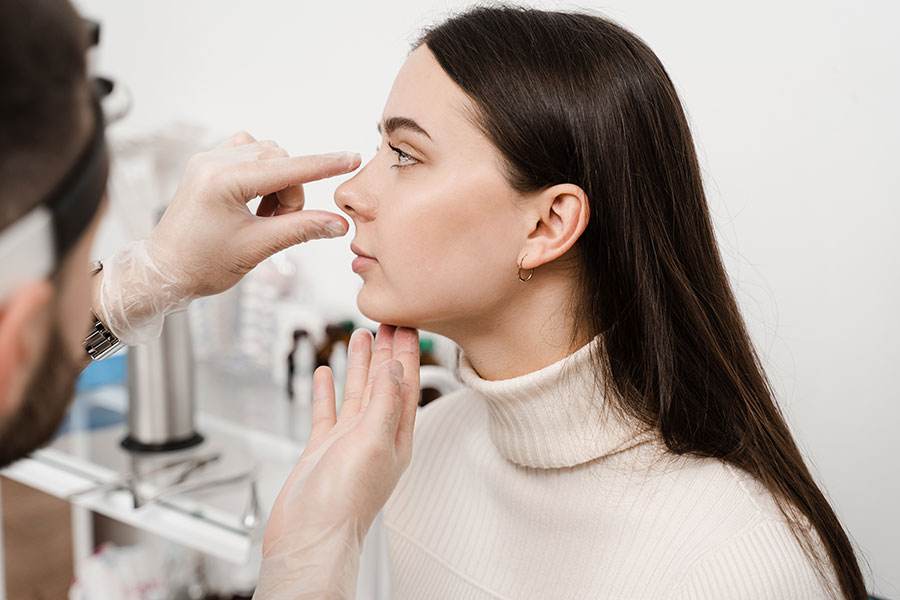
Assessing the nose 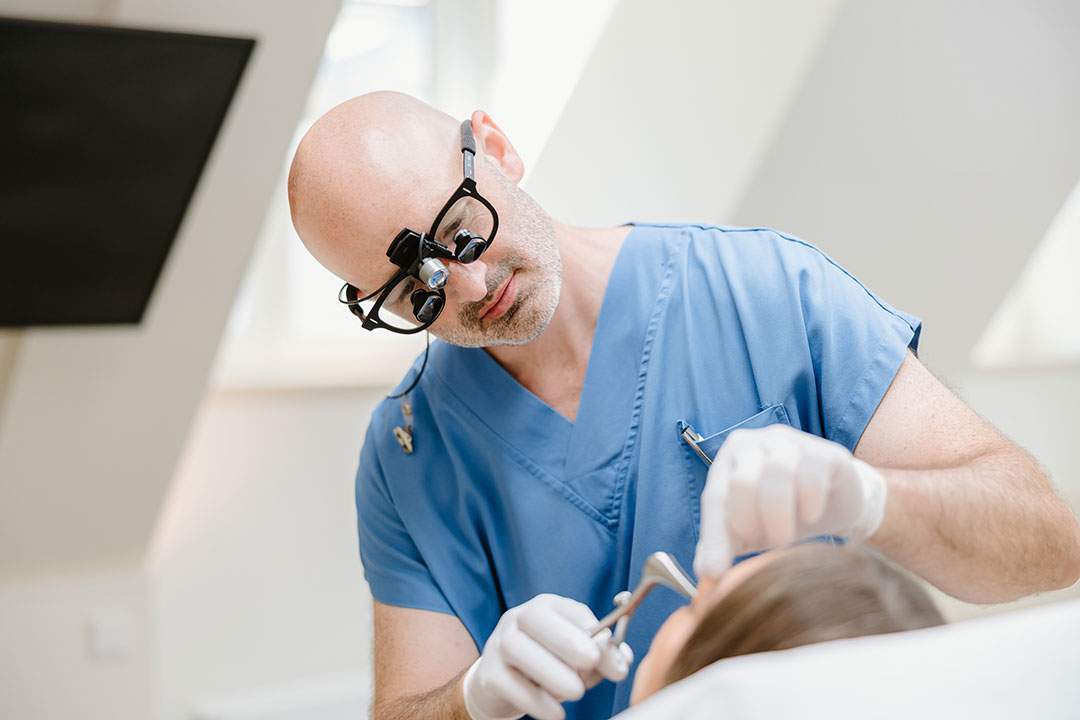
Checking nasal breathing 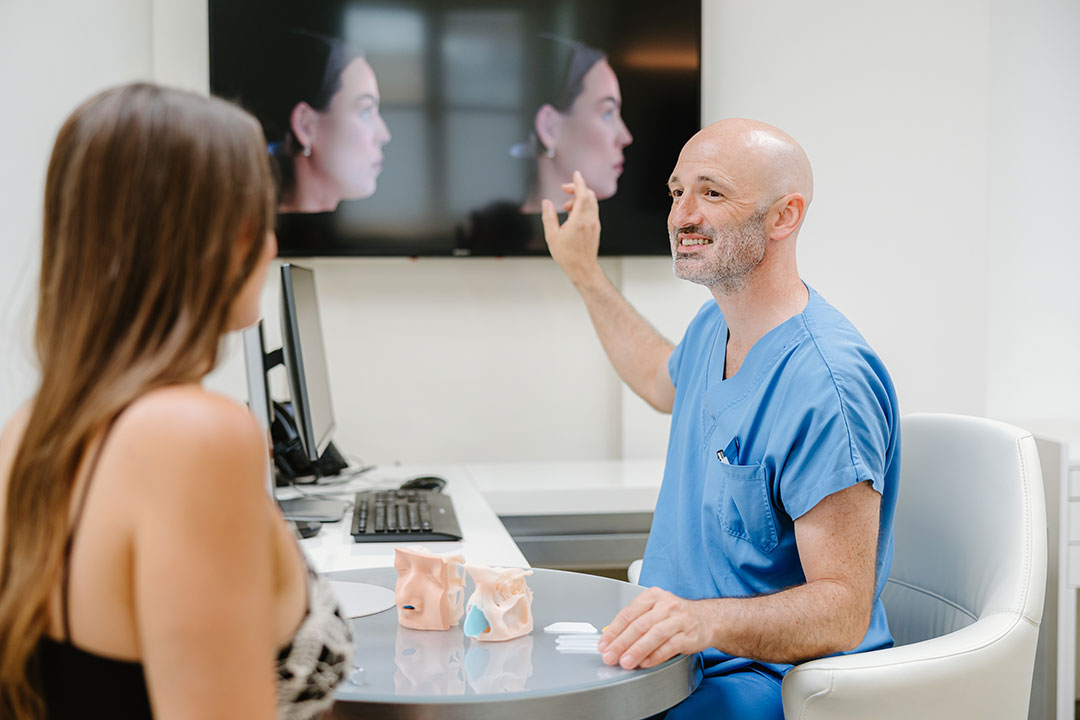
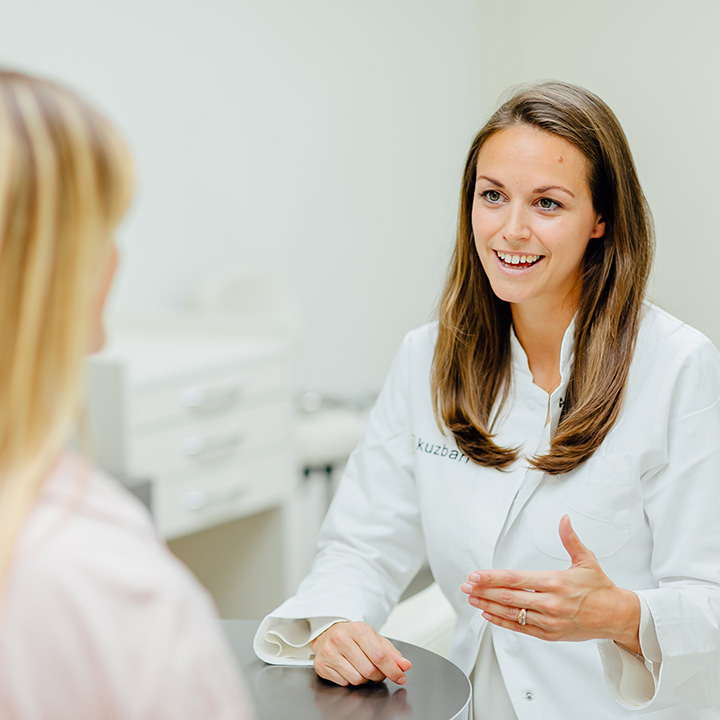
Discussing the 3D simulation
Frequently asked questions about follow-up and multiple operations
Do you also carry out revision operations?
Yes. Four in ten nasal operations at the Kuzbari Centre are revision rhinoplasties on a nose that has already been operated on. Such procedures call for particular experience: the tissue is scarred, cartilage is sometimes missing, and the starting point is different for every patient. We deliberately take on such cases.
How long do I have to wait after the previous operation?
As a rule at least twelve months. As long as the swelling has not fully subsided, it cannot be judged with certainty what genuinely needs correcting. You can come for a consultation earlier all the same; in rare cases, such as clearly obstructed breathing, an earlier procedure makes sense.
Why is a revision more demanding?
Because the anatomy has changed. The tissue is scarred and stuck together, the cartilage reserve in the septum is often already used up, and the blood supply differs from that of an untouched nose. This makes dissection slower and frequently calls for grafts from the ear or a rib.
Where does the cartilage come from when the septum is used up?
From the ear — through a small incision at the back, without changing the shape of the ear — or, where more is needed, from a rib. Rib cartilage is stable enough to replace load-bearing parts of the framework. We discuss the harvesting beforehand in detail, including the additional scar.
Can everything be corrected?
No, and we say so beforehand. Some things can be corrected completely, others improved considerably, and in a few places a trace remains. What applies in your case we show you on your own images and on the 3D simulation.
What should I bring to the initial consultation?
The operation report of the previous procedure, any findings and photographs from before it. The operation report tells us which technique was used and how much cartilage has already been taken — that saves time and uncertainty in the second procedure.
Is breathing treated as well?
Nasal breathing is examined from the inside in every revision. If it is restricted — by a weakened septum or collapsing nasal valves, for instance — we treat that in the same procedure wherever possible.
Does healing take longer than the first time?
The return to everyday life is similar: fit for work after three to seven days, fit to socialise after one to three weeks. Because of the scar tissue the swelling often lasts longer, however, and the final result can become visible later than after a first operation.
Do I need nasal packing?
No. At the Kuzbari Centre nasal packing is not necessary. After the operation you wear a nasal splint or a nasal plaster for around ten days.
How long does the operation take?
A rhinoplasty here takes one to four hours. That range is deliberate: we operate in our own operating theatres and therefore without time pressure — for as long as it takes for every detail to be right. With a revision the duration is usually at the upper end, because releasing scar tissue takes time.
What does a revision cost?
Depending on complexity, from 9,950 euros, from 10,900 euros or from 11,900 euros, everything included. A first operation starts at 9,350 euros. You receive the binding cost estimate after the examination.
Can I just come for advice?
Of course. Many people come first simply to have what they are seeing put into context. The consultation is without obligation, and we push no one into an operation — least of all a second one.
Your consultation
Over an hour of time, an examination from the outside and the inside, a 3D simulation and an honest assessment of what can be improved on your previously operated nose — without obligation.
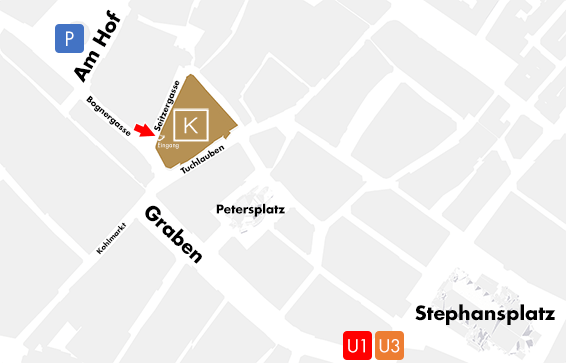
Monday to Friday, 08:00 to 18:00 · Seitzergasse 2-4, 1010 ViennaBook an appointment for your
rhinoplasty now!
Facial surgery is among the areas of focus at the Kuzbari Centre. That is why three specialists with us deal exclusively with the "supreme discipline" of plastic surgery, and whichever of them you decide on: all stand for genuine bespoke work, the highest possible quality and the greatest possible safety. You will find the appointment booking for Univ. Doz. Dr. Rafic Kuzbari on this page.
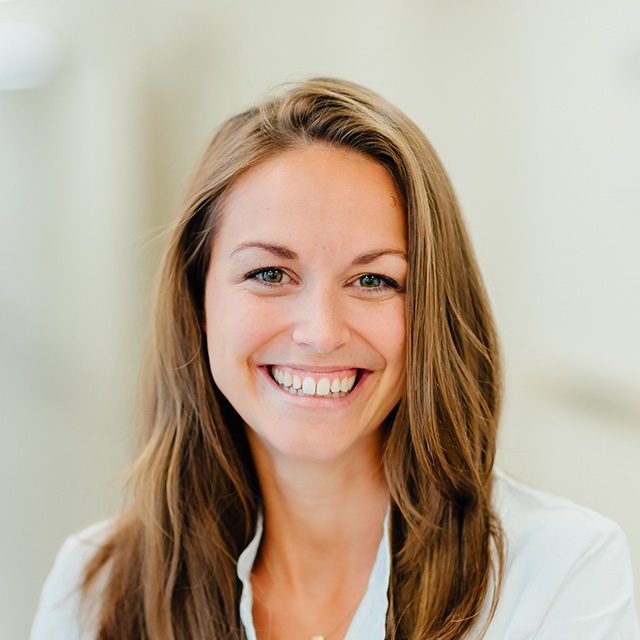
In the following overview you can book appointments with our rhinoplasty specialists Dr. Christoph Grill and DDr. Jessica Wittmann.
Here you will find an overview of our rhinoplasty experts:
Details & appointment booking
3D simulation
Inpatient procedure
with overnight stay
Kuzbari
operating wing
Kuzbari
Safety Check
Kuzbari
quality guarantee
Photo documentation
2-3 weeks
downtime
Aftercare
Details & appointment booking
3D simulation
Inpatient procedure
with overnight stay
Kuzbari
operating wing
Kuzbari
Safety Check
Kuzbari
quality guarantee
Photo documentation
2-3 weeks
downtime
Aftercare
Details & appointment booking
3D simulation
Inpatient procedure
with overnight stay
Kuzbari
operating wing
Kuzbari
Safety Check
Kuzbari
quality guarantee
Photo documentation
2-3 weeks
downtime
Aftercare


 01 358 28 01
 Book now