












How thick is your skin? Why nasal skin helps decide your outcome
Why does skin thickness matter so much for the outcome of a rhinoplasty, and how can you tell how thick the skin of your own nose is? This page explains what the skin has to do with the refined shape of your nose, which technique we use on thin skin, and how to prepare for your procedure.
- Assessing skin thickness
- Nose-bridge-preserving technique
- Preparation step by step
- Final outcome 6 to 12 months
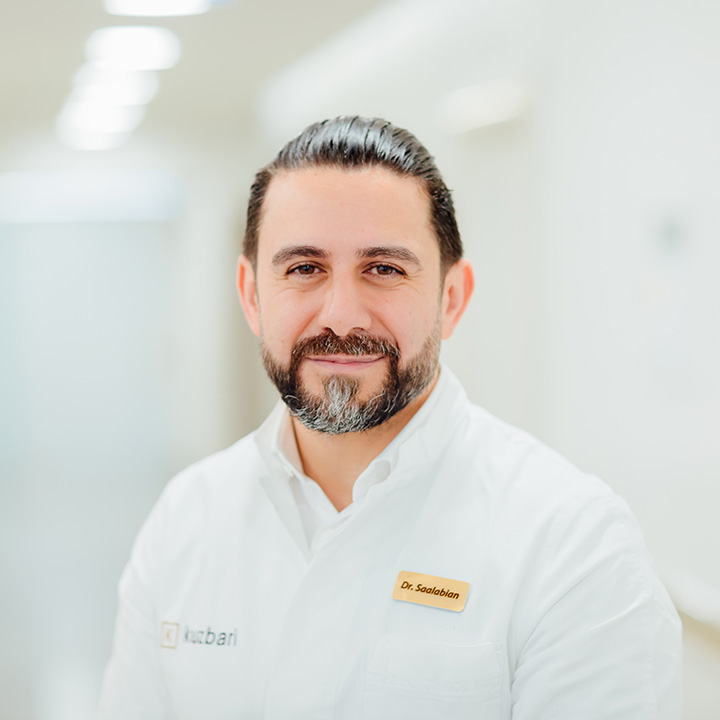
Dr. Kuzbari on skin thickness
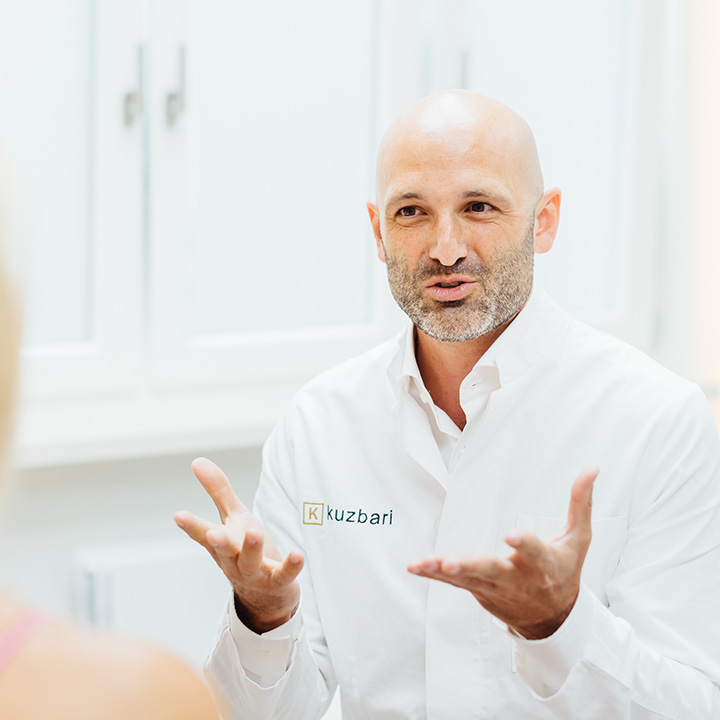
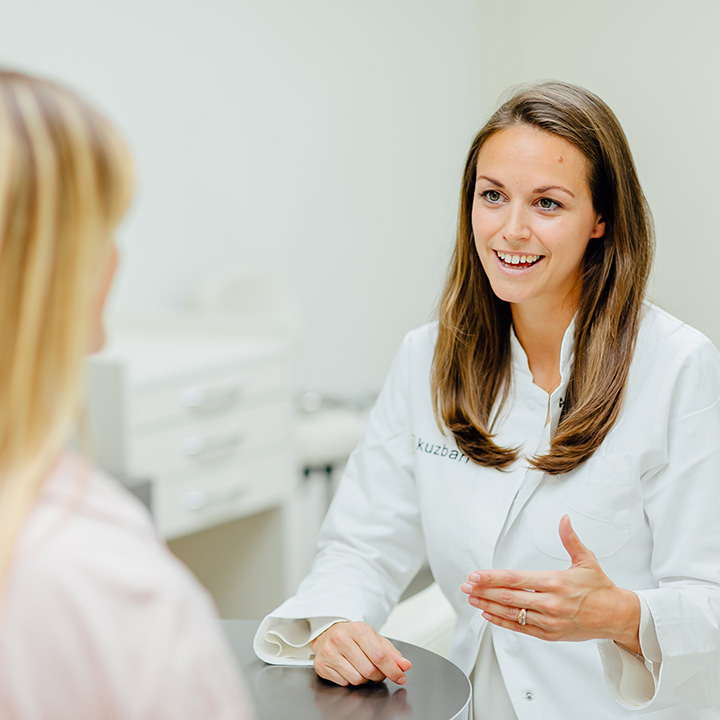
In this video Univ. Doz. Dr. Rafic Kuzbari explains aspects that matter for every rhinoplasty, the anatomical structure of the nose, and shows how anyone can test for themselves what is possible with their own nose.
Why the skin matters so much
In a rhinoplasty we alter the framework of bone and cartilage that lies beneath the skin. What you see in the mirror afterwards, however, is not that framework but the skin covering it. It is the envelope through which every change has to become visible — or fails to.
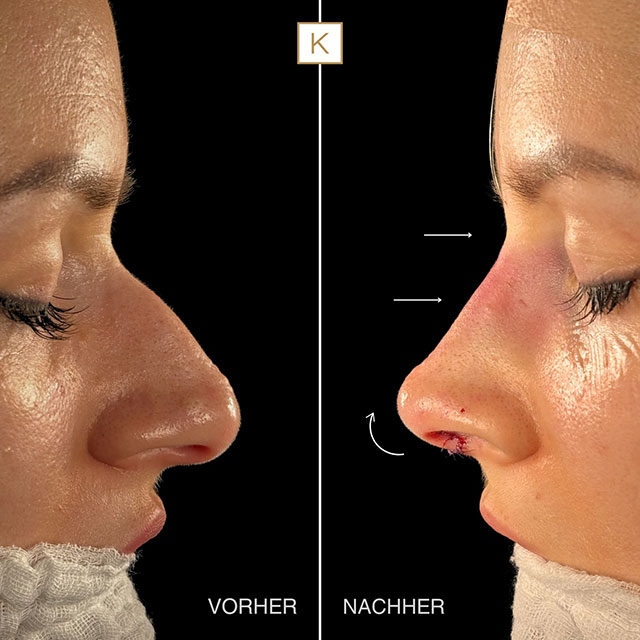
Thin nasal skin lies close against the framework and follows every contour. That is why very fine outcomes are possible with thin skin — and at the same time why every tiny edge becomes visible there. Thick, sebaceous skin conceals detail. It forgives small irregularities, but it also reveals less definition and takes longer before the swelling has fully gone.
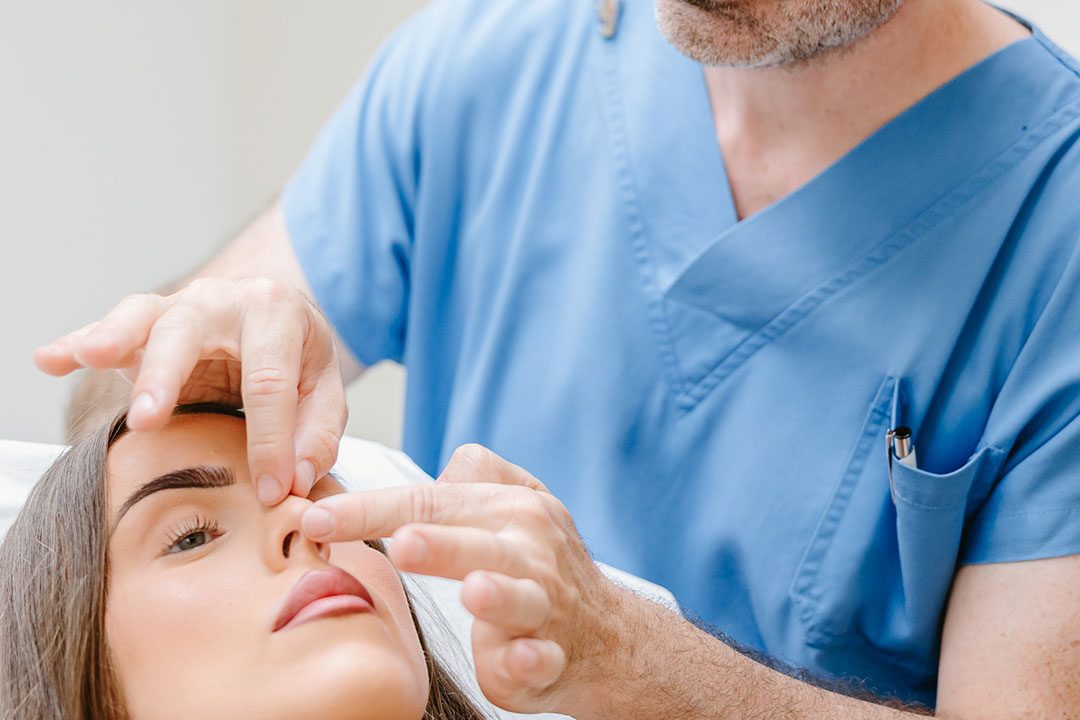
Skin thickness is not uniform across the nose. At the root and over the tip it is usually thicker, and thinnest at the transition from bone to cartilage. It is exactly at that point that it is decided whether a bridge later looks straight. That is why in the initial consultation we do not simply feel „the skin“, but each zone separately.
Felt, not guessed
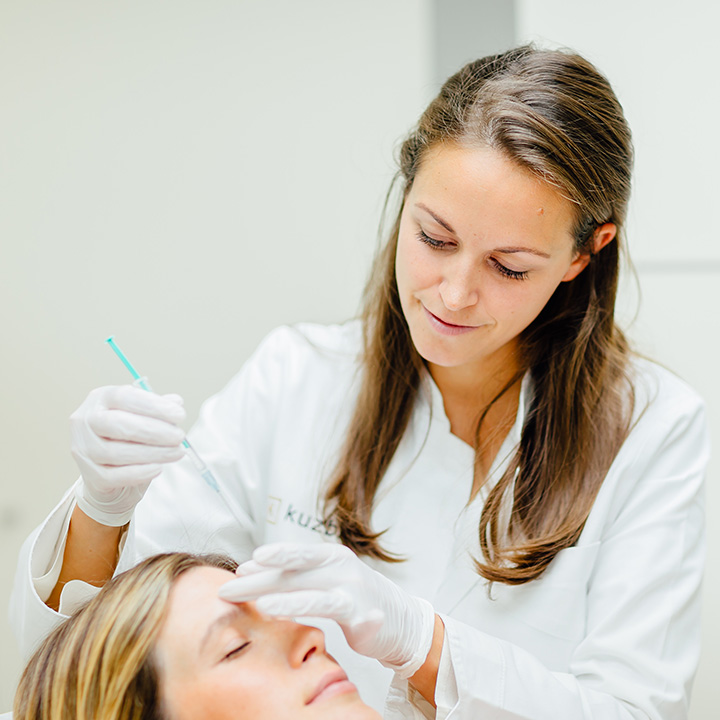
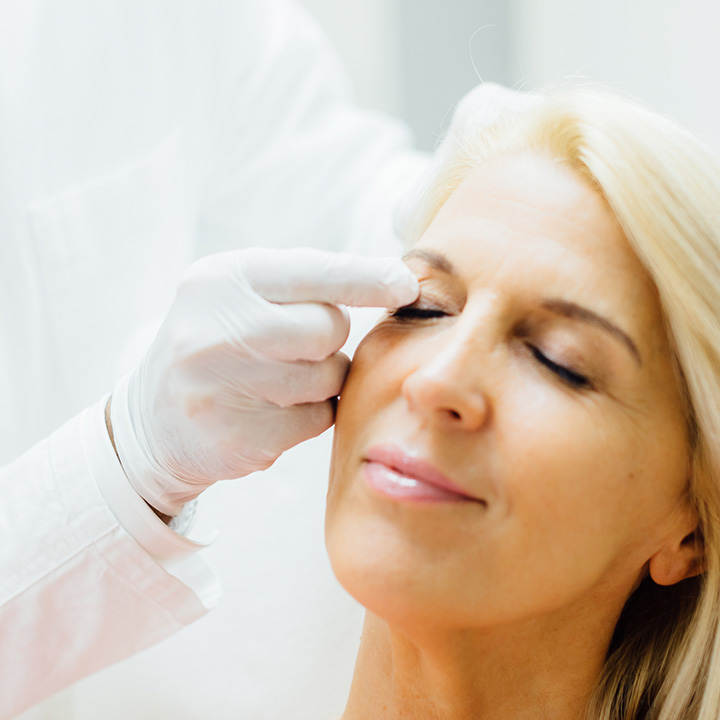
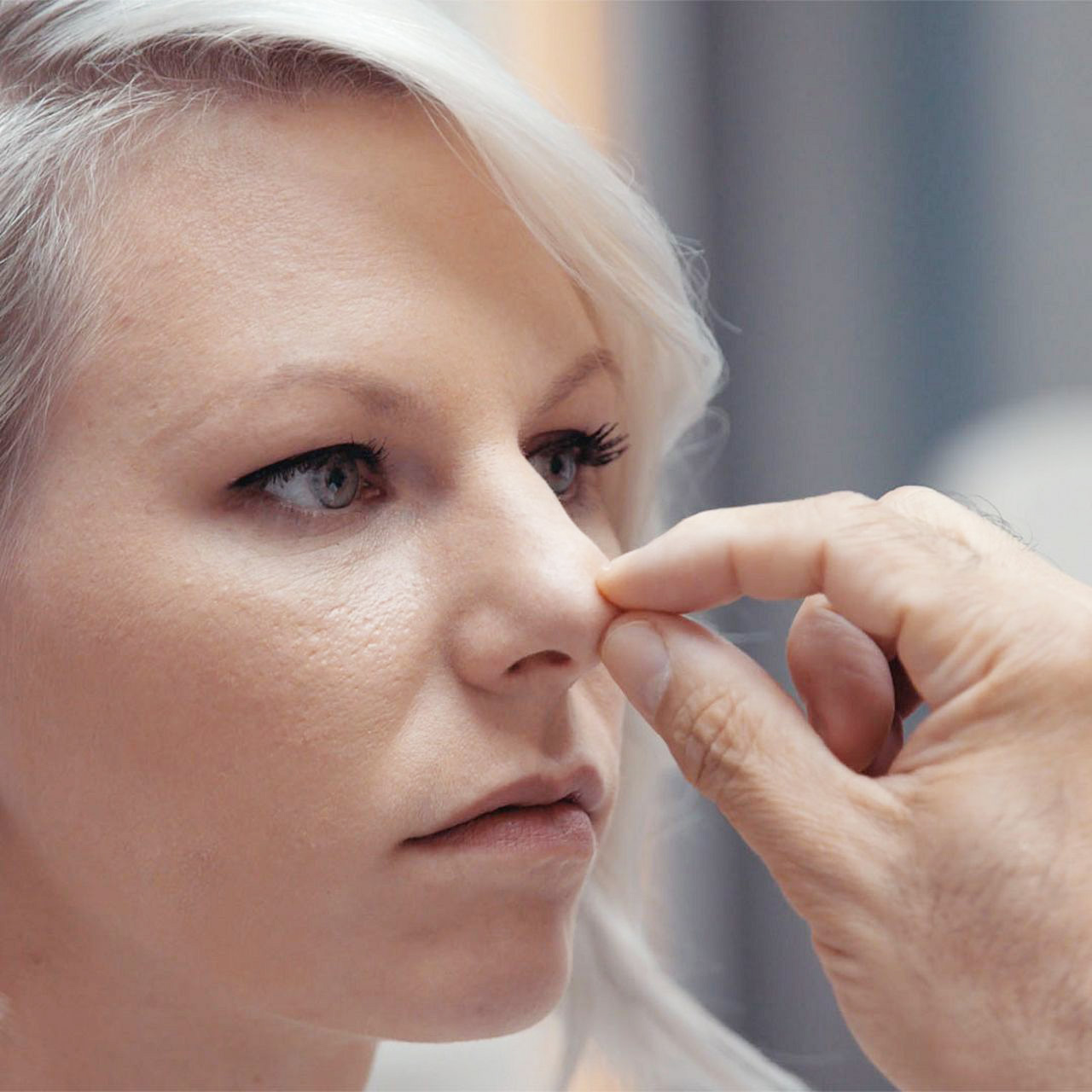
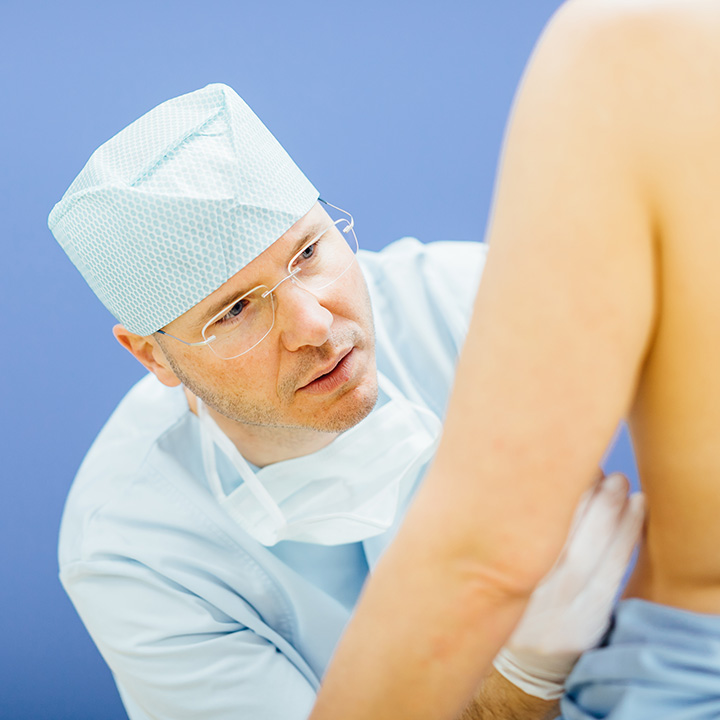
Skin thickness cannot be read off a photograph. We establish it by palpation in the initial consultation, zone by zone, and tell you what it means for your outcome — before any technique is discussed.
The self-test: a first indication
You can form a first impression yourself. It does not replace an examination, but it helps you prepare for the conversation.
- Gently pinch the skin at the side of the bridge between thumb and forefinger. If it lifts easily and feels thin, that points to thin nasal skin.
- Look at the tip of your nose in good light. If fine contours are recognisable, the skin tends to be thin. If the tip looks rounded and soft, it tends to be thick.
- Watch for visible pores and an oily sheen on the lower third of the nose. Both point to thicker, sebaceous skin.
- Compare the nose with the skin of your cheeks and forehead: people with generally oily skin usually have more sebaceous glands on the nose as well.
- Note down your impression and bring it to the initial consultation. The definitive assessment is made there by palpation.
Thin skin and the right technique
With thin nasal skin the choice of technique is especially important, because every edge will later show through. We work a great deal with the modern nose-bridge-preserving technique known as dorsal preservation, as well as with hybrid techniques — not exclusively with traditional structural septorhinoplasty. The natural bridge of the nose is preserved rather than taken down and rebuilt.
This has three advantages: the outcome looks particularly natural, it is stable in the long term, and the risk of later irregularities along the bridge goes down — which counts above all with thin skin, where every tiny edge becomes visible. Certain deviations also recur less often.
A word of perspective: the nose-bridge-preserving technique is not superior across the board. For many findings it is the gentler choice, for others structural septorhinoplasty or a combination of both is. Which route is right is decided by the findings — and your skin thickness is part of them.
We stabilise the tip of the nose using modern cartilage-supported techniques. This considerably reduces the risk of drooping of the nasal tip over the years. With thin skin this calls for particular care, because a cartilage graft that sits too sharply can later show through.
| Feature | Rather thin nasal skin | Rather thick nasal skin |
|---|---|---|
| Refinement of the outcome | Very fine work possible; contours show clearly. | Less definition; the skin conceals fine contours. |
| What we watch most closely | Edges and transitions along the bridge; often a nose-bridge-preserving approach. | Stable, clearly defined supporting structures so that the shape asserts itself. |
| Course of the swelling | Usually subsides more quickly. | Lasts longer; the refined shape appears later. |
| Final outcome | After 6 to 12 months. | After 6 to 12 months, often at the upper end of that range. |
What applies with thick skin
Thick nasal skin is no reason to rule out a rhinoplasty — it simply calls for honest expectations. A very narrow, sharply drawn tip cannot be brought out beneath thick skin; the tissue settles over it and rounds it off. What does work well are changes to size, profile and axis.
Because thick skin needs time while healing, the swelling subsides more slowly. In the first months the nose looks broader than it will end up being. We say so before surgery, so that you do not mistake month three for a result. The final outcome appears after six to twelve months.
In 2026 Dr. Christoph Grill and DDr. Jessica Wittmann spent a fellowship in Brazil working intensively with new and modern techniques of rhinoplasty, which now feed into the work at the Kuzbari Centre — with a focus on thick skin and ethnic nasal shapes. The guiding idea is to build up rather than take down: beneath thick skin a defined tip does not come from removing volume, but from a stable cartilage framework that carries the tip against the soft tissue. Added to that is careful handling of the soft-tissue envelope itself. The character of your nose is preserved in the process; a standard nose is not the goal.
Your rhinoplasty at a glance
- Initial consultationMore than an hour
- Length of surgery1 to 4 hours
- AnaestheticGeneral anaesthesia
- StayOne night
- SplintAround 10 days
- Fit for workAfter 3 to 7 days
- Socially presentableAfter 1 to 3 weeks
- Final outcomeAfter 6 to 12 months
Guide values for a rhinoplasty at the Kuzbari Centre. What applies to you depends on the scope of your procedure and is settled after the examination.
Preparing for your rhinoplasty
Between your decision and the day of surgery lies the preparation. It takes little time and is the part that makes the day of surgery a calm one.
- Informed-consent discussion
Procedure, technique, risks and alternatives are discussed and set down in writing. This is also where it is settled which medicines you stop beforehand.
- Medical history and laboratory values
Pre-existing conditions, allergies and blood values are recorded. We arrange the appointment for that with you.
- Pre-anaesthesia clinic
Anaesthetic preparation runs through the pre-anaesthesia clinic in the building. There you meet the anaesthesia team that will accompany you on the day.
- Stopping blood-thinning medicines
Which preparations this concerns is settled in the informed-consent discussion. Do not stop anything on your own; talk it through with us.
- Planning your recovery
Set aside one to three weeks in which you can take things easy. From a medical point of view most people are fit for work after three to seven days.
- Arrive fasting
Without make-up, without jewellery, in comfortable clothing that opens at the front. Arrange someone to accompany you home the following day.
DDr. Jessica Wittmann: tips on preparation
In this video DDr. Jessica Wittmann explains important tips on preparing for nasal surgery.
Number one on DocFinder
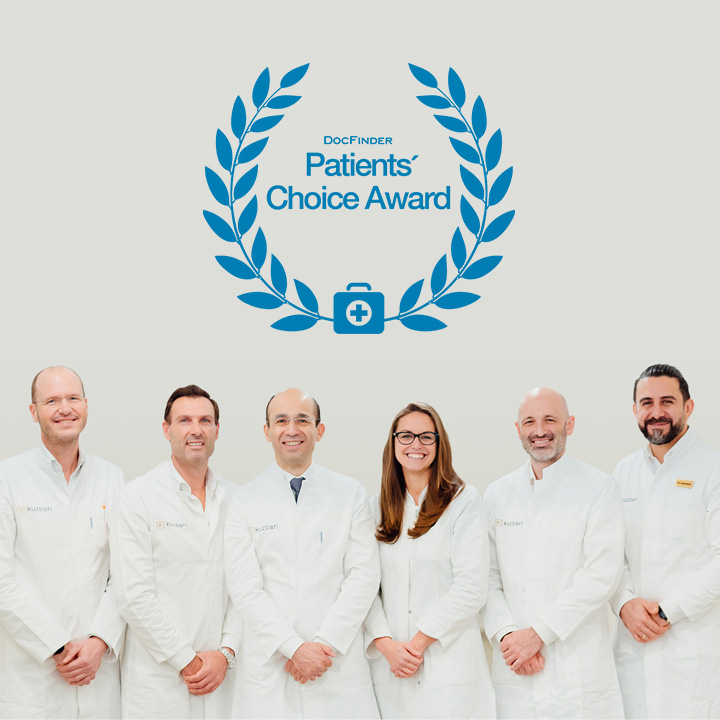
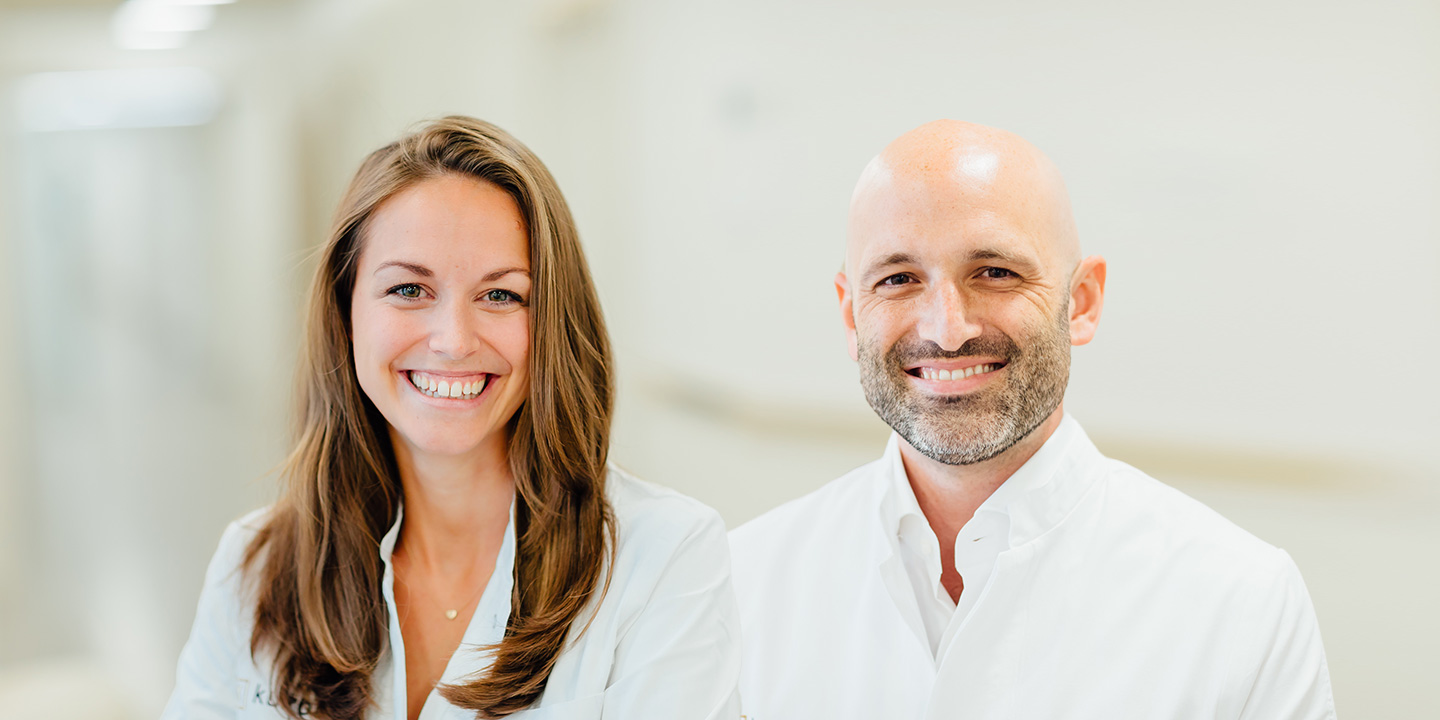
In the DocFinder ranking of Austria’s most popular plastic surgeons, the specialists of the Kuzbari Centre have taken the top places for several years in a row. The award is based on ratings from real patients. Dr. Kuzbari and Dr. Grill have each been given five stars by more than 500 of them.
In the initial consultation we palpate each zone separately — without obligation.
Frequently asked questions about skin thickness and preparation
Why does skin thickness matter so much for a rhinoplasty?
Because after surgery you do not see the framework of bone and cartilage, but the skin covering it. Thin skin follows every contour and makes very fine outcomes possible, yet it also shows every tiny edge. Thick skin conceals detail and takes longer before the swelling has gone.
Can I tell for myself how thick my nasal skin is?
You can form a first impression: if the skin at the side of the bridge lifts easily and feels thin, that points to thin nasal skin. Visible pores and an oily sheen on the lower third point to thicker skin. The definitive assessment is made by palpation in the initial consultation.
Is thin skin better than thick skin?
No. They are two starting points that call for different planning. What counts is that the technique suits the skin and that you know beforehand what to expect.
Which technique do you use on thin skin?
Often the modern nose-bridge-preserving technique known as dorsal preservation, as well as hybrid techniques. The natural bridge of the nose is preserved rather than taken down and rebuilt. The risk of later irregularities along the bridge goes down — which counts particularly with thin skin.
Does healing take longer with thick skin?
The swelling usually subsides more slowly, and the refined shape appears later. The final outcome appears after six to twelve months, with thick skin often at the upper end of that range.
Which medicines do I have to stop before surgery?
Which preparations this concerns is settled in the informed-consent discussion — as a rule blood-thinning medicines around two weeks before the procedure. Do not stop anything on your own.
How does the anaesthetic preparation work?
Through the pre-anaesthesia clinic in the building. Medical history and laboratory values are discussed there, and you meet the anaesthesia team that will accompany you on the day of surgery.
What should I bring on the day of surgery?
Come fasting, without make-up and without jewellery, in comfortable clothing that opens at the front. Please arrange someone to accompany you home the following day.
How much time off do I need?
From a medical point of view most people are fit for work after three to seven days. You are socially presentable after one to three weeks. Plan that time in before fixing a date for surgery.
Does smoking affect the outcome?
Smoking delays wound healing. Raise it openly in the informed-consent discussion; we will then go through what to watch out for before and after surgery.
Your consultation
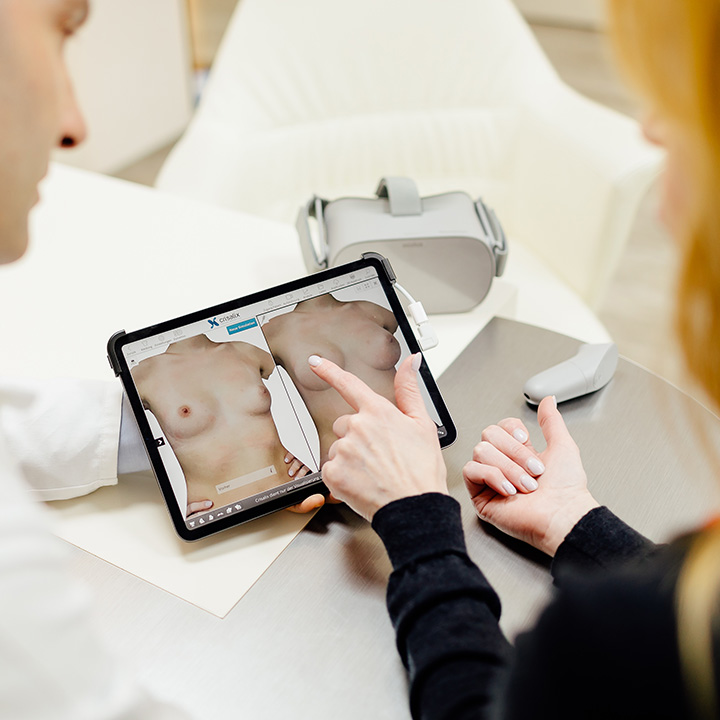
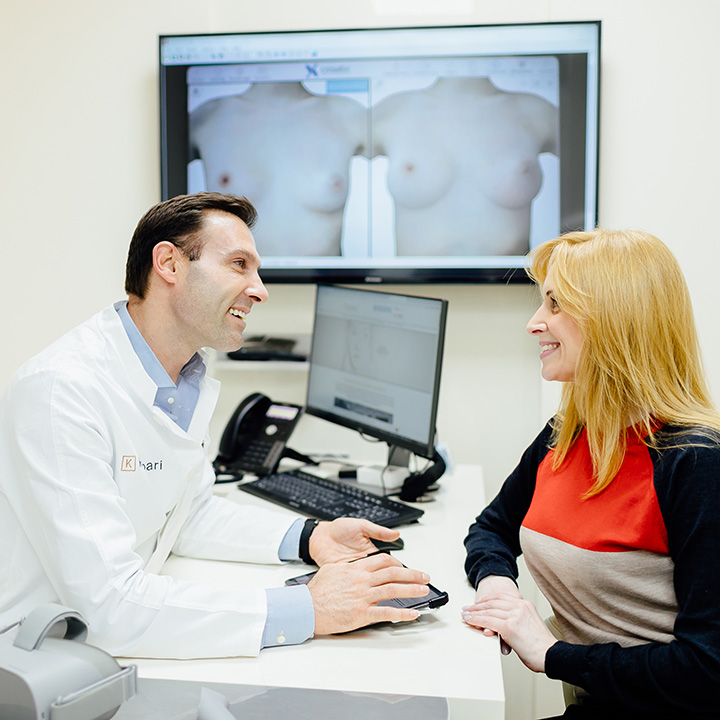
More than an hour of time, an examination from outside and inside, an assessment of your skin thickness and a 3D simulation — without obligation.
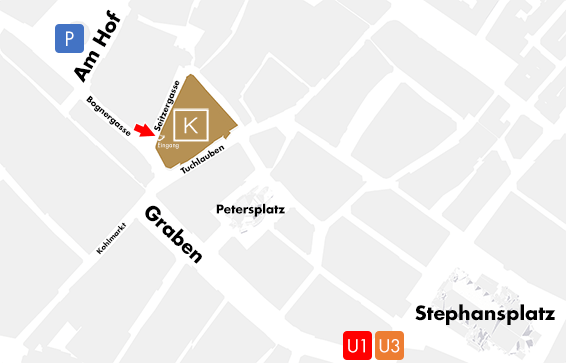
Monday to Friday, 08:00 to 18:00 · Seitzergasse 2-4, 1010 Vienna



 01 358 28 01
 Book now