






























Which nose shape do I have?
There is no single perfect nose. With every rhinoplasty the result is a new nose tailored individually to the face. The aim is usually for the nose to blend unobtrusively into the face.

What is of interest is which shape the nose has before the operation – that is, the starting situation. This is determined by our genes; sometimes the shape of the nose can also change through fractures or accidents. We distinguish the following nose shapes before a correction:
The hump nose
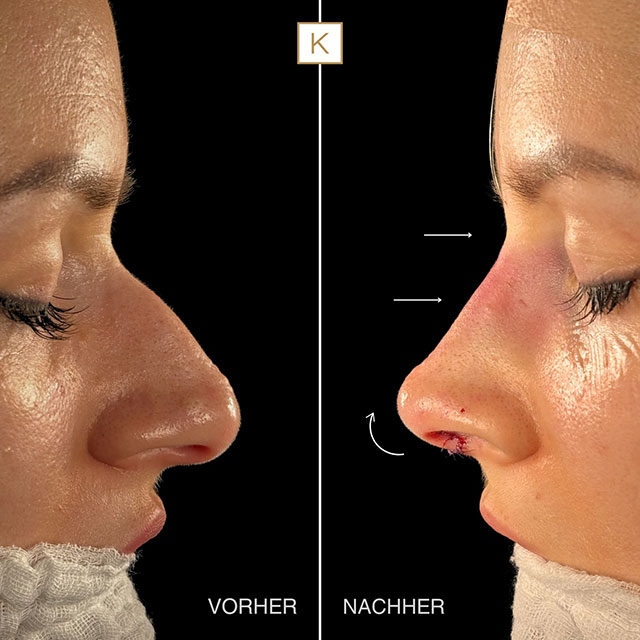
The nasal dorsum has a conspicuous hump. This can consist of the cartilaginous or the bony part of the nose, or of both parts. The hump is usually congenital, but it can also have arisen after a broken nose. In the course of a rhinoplasty it is reduced, so that a straight nasal dorsum is created in profile.
The hooked nose
This nose shape is very similar to the hump nose. By a hooked nose, however, we mean a nose whose tip points downwards and whose dorsum therefore curves in the shape of a hook. The nasal dorsum can then be straightened surgically and the nasal tip lifted.
The broad nose
We speak of a broad nose when the nose is disproportionately broad in relation to the face. This can concern the nasal dorsum as well as the nasal tip and the nostrils. With broad noses the nasal tip is often not beautifully defined either. In the rhinoplasty, therefore, the nasal dorsum and the nasal tip are usually adjusted in these cases.
The button nose
Many see a button nose as the dream idea of a perfect nose. If it is excessively ‘snub’, however, it can also be troublesome. Sometimes the button nose then seems too short for the face or lifted too far upwards, which is called ‘rotated’ upwards. Too pronounced a step between the nasal tip and the nasal dorsum also comes under this, something that many people like in a delicate form.
The crooked nose
A crooked nose is, as the name already reveals, crooked. That means that the nasal tip leans markedly to the left or right and the nasal dorsum is accordingly bent in a C or S shape. The crooked nose can be the result of a broken nose, but it is often congenital too. Frequently a deviated septum lies behind it.
The balloon nose
A balloon nose shows in nostrils that are ‘inflated’ outwards at the sides. As a result the nostril openings look disproportionately large in relation to the nose.
The saddle nose
The saddle nose describes more or less the opposite of the hump nose. It has an unflattering depression on the nasal dorsum, which shows particularly in profile ‘like a step’, while from the front the nose usually looks broad and clumsy. The cause of this can be quite different things, such as injuries, previous operations that turned out badly, inflammation or conditions that lead to a breakdown of cartilage.



 01 358 28 01
 Book now